Real life. Real thoughts. The messy middle of motherhood, mental health, and figuring it out. The space between staying and leaving, between healing and hurting.
Where It Started
Before the heartbreaks, before the failed relationships, before the questions. I was learning what love felt like. This is a raw story about childhood, emotional survival, attachment wounds, and finally understanding where it all started.
~Tj🩷
6 min read
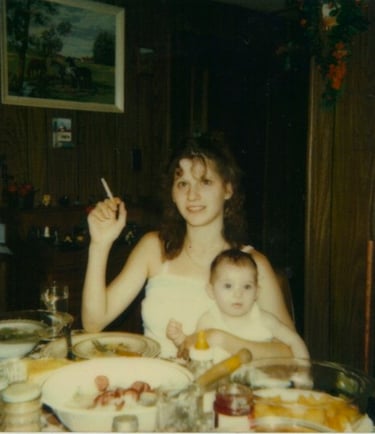

I think every relationship I’ve ever had started long before I realized it. Before the men. Before the heartbreak. Before I learned how to love like it was something I had to earn. It started with her.
My mom.
I don’t know how to explain our relationship in a way that makes perfect sense… because it never really did. It wasn’t all bad. That’s what makes it harder to understand. There were moments of love. Moments where I felt seen. But they weren’t consistent. They didn’t stay. And inconsistency like that teaches you something early—even if you don’t have the words for it yet.
And when you grow up like that, you don’t question it.
You adjust. You learn how to read the room. You learn how to keep the peace. You learn that love can feel warm one minute and distant the next. So you start working for it. Trying to be easier. Calmer. Better. Less “too much.” You learn emotional survival before you even understand emotional safety.
And without realizing it, that becomes your normal.
You grow up thinking that’s what love is—something you earn, something you manage, something that can be taken away if you get it wrong. I think that’s where it started for me—that quiet belief that if I could just get it right, things would finally feel steady.
But steady never came.
Looking back now, I realize how much of my life was spent trying to create stability where stability didn't actually exist. I thought if I loved harder, explained myself better, stayed longer, forgave more, or became less difficult to love, things would finally settle. I believed consistency was something I could earn through effort. The problem is that healthy love doesn't work that way. Healthy relationships aren't built on constantly proving your worth. They aren't maintained through exhaustion.
The truth is, when you grow up learning to anticipate people's moods, learning to read a room before you speak, learning how to avoid becoming a problem, that skill follows you into adulthood. It becomes second nature. You don't walk into relationships asking, "Do I feel safe here?" You walk into them asking, "How do I keep this from falling apart?" Those are two very different questions, and for a long time I didn't know the difference.
Research on attachment theory suggests that the relationships we experience during childhood often shape what feels familiar to us as adults. Familiar isn't always healthy. Sometimes familiar is inconsistency. Sometimes familiar is unpredictability. Sometimes familiar is spending your life trying to win love that should have been freely given in the first place. We don't necessarily chase what is best for us. We often chase what feels recognizable.
So instead, I learned to question myself. Was I too much? Did I say something wrong? Am I the problem? And that kind of thinking doesn’t stay in childhood—it follows you into every relationship, every connection, every version of yourself you try to build after.
And the hardest part is… you don’t even realize you’re doing it.
You think you’re just loving someone.
You think you’re just trying.
You think this is what effort looks like.
But really, you’re repeating something that was taught to you before you even had a choice.
You’re over-explaining.
Overthinking.
Overextending.
Trying to feel secure in something that never actually feels stable.
And it shows up in ways that don’t always look obvious. In the way you stay longer than you should. In the way you give chances that don’t get earned. In the way you question yourself instead of questioning what’s being given to you.
It becomes less about connection…and more about trying to get it right.
Trying to finally be chosen in a way that feels consistent.
And that’s the part I’m starting to see now. That it was never about being “too much.” It was about being taught to shrink in order to be loved.
And unlearning that?
That’s where I am now. I think that’s the part that messes with you the most realizing it wasn’t random. It wasn’t just “bad luck” in relationships. It wasn’t just choosing the wrong people.
It was familiar.
That realization hit me harder than almost anything else. Not because it gave me answers, but because it connected dots I wasn't ready to connect. Suddenly I could see the pattern stretching across years. Different people. Different faces. Different circumstances. The same ache underneath all of it.
The same need to feel chosen.
The same fear of being abandoned.
The same habit of making excuses for behavior that hurt me because understanding someone felt easier than holding them accountable.
That's a difficult thing to admit about yourself. It means looking at your own role in the story. Not taking responsibility for what others did, but recognizing the ways you've adapted to survive it. Sometimes survival skills become relationship habits. Sometimes the very things that protected you as a child become the things that hurt you as an adult.
It felt like something I already knew how to navigate. Something I had been practicing my whole life without realizing it.
Because when love starts off inconsistent…you don’t go looking for steady.
You go looking for what feels recognizable.
Even if it hurts.
Even if it confuses you.
Even if part of you knows it isn’t right.
There’s something almost comforting about the chaos when it’s all you’ve known. And that’s a hard thing to admit.
Because it means I wasn’t just in those situations—
I understood them.
Maybe that's why peace felt so strange whenever it appeared. Chaos was familiar. Uncertainty was familiar. Waiting for the other shoe to drop was familiar. But calm? Calm felt suspicious. Consistency felt temporary. Part of me was always waiting for something to change because somewhere along the line I learned that good things rarely stayed.
Psychologists sometimes refer to this as emotional conditioning. When inconsistency becomes your normal experience, your nervous system begins to expect it. You stop reacting to dysfunction because dysfunction feels ordinary. What actually feels uncomfortable is safety. Predictability. Reliability. That's why healing can feel so backwards at times. You're not only learning new patterns. You're challenging old ones that have been running in the background for decades.
I knew how to survive in them.
What I'm learning now is that surviving and feeling safe are not the same thing.
For years I confused the two.
I thought because I could endure something, it meant it was meant for me.
I thought because I understood someone's pain, I had to tolerate the ways they caused pain.
I thought loyalty meant staying.
I thought love meant sacrificing.
I thought being chosen was the goal.
Now I think the goal is peace.
Not perfection. Not certainty. Not getting every answer I've spent years searching for.
Peace.
The kind that doesn't require me to shrink myself.
The kind that doesn't require constant explanation.
The kind that doesn't disappear the second I stop proving my worth.
And maybe that's what this chapter is really about. Not grieving what happened. Not blaming anyone. Not rewriting the past.
Just finally learning the difference between what feels familiar and what actually feels like home.
I knew how to adjust myself just enough to stay.
And for a long time, I thought that meant I was strong. That I could handle more. That I could love harder. That I could fix what felt broken.
But the truth is…
I was just repeating something I hadn’t healed yet. And that realization?
That one stings a little.
Because it forces you to look at your own patterns. Your own choices. The ways you’ve stayed in things that didn’t feel right, not because you didn’t know…
but because it felt normal.
And I’m not writing this from some “I have it all figured out now” place. I’m writing this from the middle of it. From the awareness stage.The part where you start seeing it clearly…
but you’re still learning how to choose differently.
Still catching yourself in the overthinking.
The overgiving.
The quiet hoping that this time it’ll feel different.
And maybe that’s what this really is—
not an ending. Not a resolution. Just the point where I finally understand where it started…
and why it followed me for so long.
~Tj🩷