Real life. Real thoughts. The messy middle of motherhood, mental health, and figuring it out. The space between staying and leaving, between healing and hurting.
When Every Little Sound Makes You Want to Crawl Out of Your Skin
Small sounds driving you insane? Learn why sound sensitivity and overstimulation happen—and why loud music can actually help regulate your nervous system.
4 min read
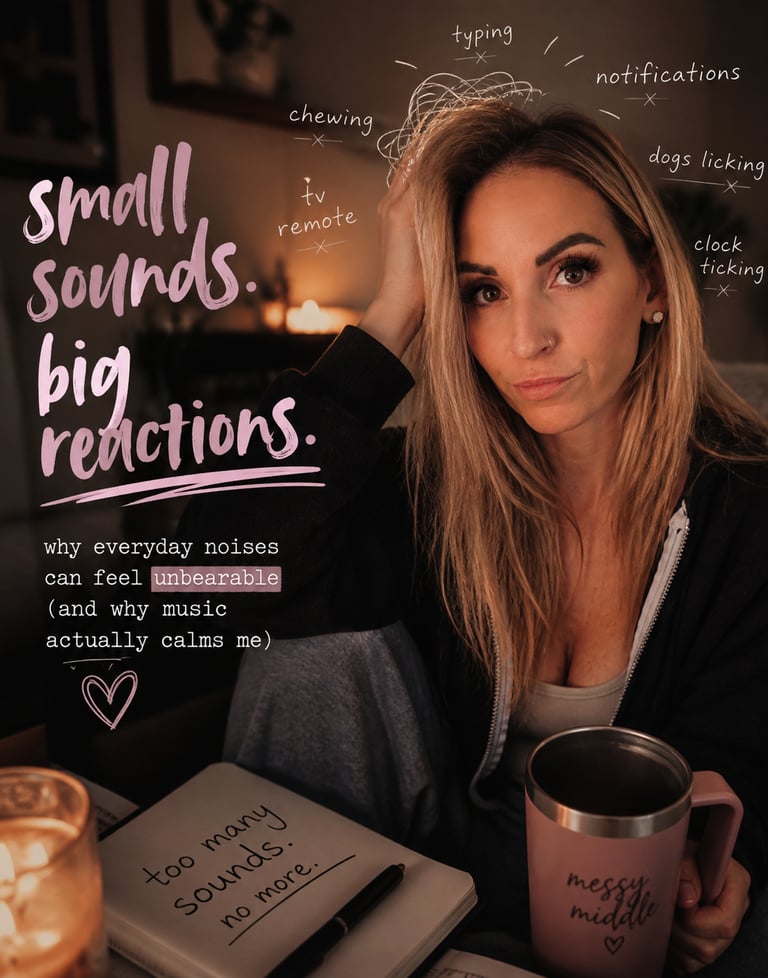

Being sensitive to sound is not just “being annoyed.” For some people, everyday noises like typing, chewing, or notifications can trigger real irritation, overstimulation, and emotional reactions—while something like loud music can actually feel calming.
Some sounds don’t just bother me—they go through me. It’s not a casual irritation. It’s immediate. My body reacts before my brain even has time to step in and be reasonable. The smallest noise can flip a switch so fast it feels like my nervous system just decided we’re done here.
And it’s never the sounds people expect. It’s not always loud chaos or obvious noise. It’s the small, repetitive, everyday things that somehow feel the loudest. The click of a TV remote. Typing on a keyboard. Someone chewing. A clock ticking in the background like it’s intentionally trying to ruin my life. My dogs panting, drinking water, cleaning themselves—and the licking. The constant, repetitive licking of a treat that somehow lasts forever. I can’t do it.
It sounds dramatic until you’re the one sitting there trying to stay calm while your entire body feels like it’s reacting to something no one else even notices. And the worst part is how it comes out sometimes. There was a moment that stuck with me—Hayden was sitting there doing schoolwork, just typing on her laptop. Nothing wrong. Nothing loud. Just typing. And I felt it immediately. That sound went straight through me. I got irritated fast and snapped, asking if she was almost done. She went to her room to finish, and I sat there feeling awful, because the truth is I should have been the one to walk away.
That’s the part people don’t see with sound sensitivity. It’s not just the irritation—it’s the guilt that follows. Knowing your reaction feels bigger than the situation. Knowing you don’t want to hurt people, but your body reacts before your patience has a chance to catch up. It’s exhausting, and it makes you question yourself. Why does this bother me so much? Why can’t I just ignore it? Why does something so small feel so big?
For a long time, I thought it meant I was just irritable or overly sensitive. But it’s not that simple. It’s overstimulation. When your brain is already dealing with stress, emotions, lack of sleep, or just carrying too much, it doesn’t take much to push it over the edge. Sounds start stacking. Your brain stops filtering. Everything feels louder than it actually is, and then one small noise becomes the breaking point.
Even things like phone sounds can set it off. Notifications going off one after another because someone sends ten separate texts instead of one? Instant irritation. Keyboard sounds on a phone? Absolutely not. Those get turned off immediately. Every new phone, same rule. It’s not just the sound—it’s the repetition, the unpredictability, and the fact that I can’t control it.
That’s where things finally started to make sense for me. Because the part that used to confuse me the most is this: the smallest sounds can make me feel like I’m crawling out of my skin, but I can blast music as loud as I want and somehow feel calm. That should feel overwhelming, but it doesn’t.
Because it’s not about volume. It’s about control.
The sounds that bother me are random. I don’t choose them. I can’t stop them. My brain doesn’t know when they’ll end, so it locks onto them. Music is the opposite. I choose it. I control it. I know what’s coming next. It gives my brain one consistent thing to focus on instead of ten different irritating sounds competing for attention. It drowns everything else out and replaces chaos with something steady. It’s not just noise—it’s regulation.
Once I understood that, I stopped judging myself for needing it. Because for a long time, I thought something was wrong with me. I thought I was just easily annoyed or impatient. But the truth is, not everyone experiences sound the same way. Some people filter it out without thinking. Some of us hear everything. And when your brain is constantly taking in that much input, it makes sense that it reaches a limit faster.
There’s even a term for strong reactions to certain sounds—misophonia. Not everyone has it, but a lot of people recognize that instant emotional reaction to things like chewing, tapping, or repetitive noises. That reaction is real. But understanding it doesn’t mean I get a free pass to snap at everyone around me. My feelings may be valid, but how I respond still matters.
I don’t want my kids or the people around me to feel like they’re doing something wrong just by existing. So I’m learning to catch it earlier. To notice when I’m getting overstimulated before I hit that point. To step away instead of sitting there letting it build. To put music on instead of pushing through until I’m irritated at everything. To give myself what I actually need instead of ignoring it.
Because sometimes the sound isn’t really the problem. Sometimes it’s the signal. A signal that I’m overwhelmed, that my nervous system needs a break, that I’ve been pushing myself a little too hard for a little too long. And when I look at it that way, it shifts things. Instead of just reacting, I can ask myself what I need—quiet, space, music, a reset.
This isn’t about becoming someone who’s never bothered by anything. That’s not realistic. It’s about understanding how I work and responding better before everything feels like too much. And if you feel this too—if the smallest sounds get under your skin, if you feel overwhelmed by things other people barely notice, if you need noise sometimes and silence other times just to feel okay—you’re not broken.
You’re overstimulated.
And there’s a difference.
~Tj🩷